

The Silent Threat Underground
How Tree Roots and Clay Soils Cause Subsidence and Heave
As a homeowner, discovering a jagged crack running down your living room wall or noticing that your front door suddenly refuses to close properly can be incredibly distressing. While there are many reasons a building might experience structural movement, one of the most common—and most misunderstood—causes in the UK relates to the invisible battle happening directly beneath your foundations. It is a battle between the natural geology of the earth and the vegetation we plant upon it.
At Istidam Consulting, our structural engineers are frequently called upon to investigate tree root subsidence and building distortion. By analysing our extensive field data alongside extensive geotechnical literature, we consistently find that the combination of shrinkable clay soils and high water demand trees is a leading cause of subsidence.
In this comprehensive guide, we will explore the precise mechanisms behind clay soil subsidence and ground heave, identify the worst trees for subsidence, and explain how our expert subsidence surveys can diagnose and resolve these complex geotechnical issues.
The Mechanics of the Ground: Cohesive vs. Non-Cohesive Soils
To understand why trees can cause such catastrophic damage to a building, you first have to understand the ground upon which the building stands. In the world of geotechnical engineering, soils are broadly categorised into two main types: cohesive and non-cohesive.
- Non-cohesive soils consist of materials like gravels and fine sands, which inherently lack cohesion and possess no plasticity.
- Cohesive soils, on the other hand, are the various types of clay and silt. These soils possess both cohesion and plasticity, meaning their physical state changes dramatically depending on their water content.
Not all clays behave the same way; they range from firm, stable clays with relatively low water content to highly shrinkable clays that hold massive amounts of water.
The higher the water content within the clay, the more susceptible it is to climatic changes and seasonal movement.
During the winter months, when rainfall is excessive, these shrinkable clays absorb water and expand in volume. Conversely, during the hot, dry summer months, the clay loses its water content and drastically contracts; a process known as desiccation. In extreme cases, shrinkable clays can physically expand and contract by between 50mm and 75mm on a purely seasonal basis.
The Thirsty Giants: How Tree Roots Cause Subsidence
While seasonal weather changes cause natural expansion and contraction, the presence of trees near houses and dense vegetation accelerates and severely exacerbates this process. Trees require large amounts of water to survive, grow, and carry out photosynthesis.
- Much of this water is actively drawn up through the tree’s extensive subterranean root system.
- To put this into perspective, a single mature poplar tree can extract up to 50,000 litres of water from the sub-soil every single year.
- Fast-growing root systems, like those of poplars and elms, can extend over considerable distances and extract vital moisture from as deep as 6 metres below the ground surface.
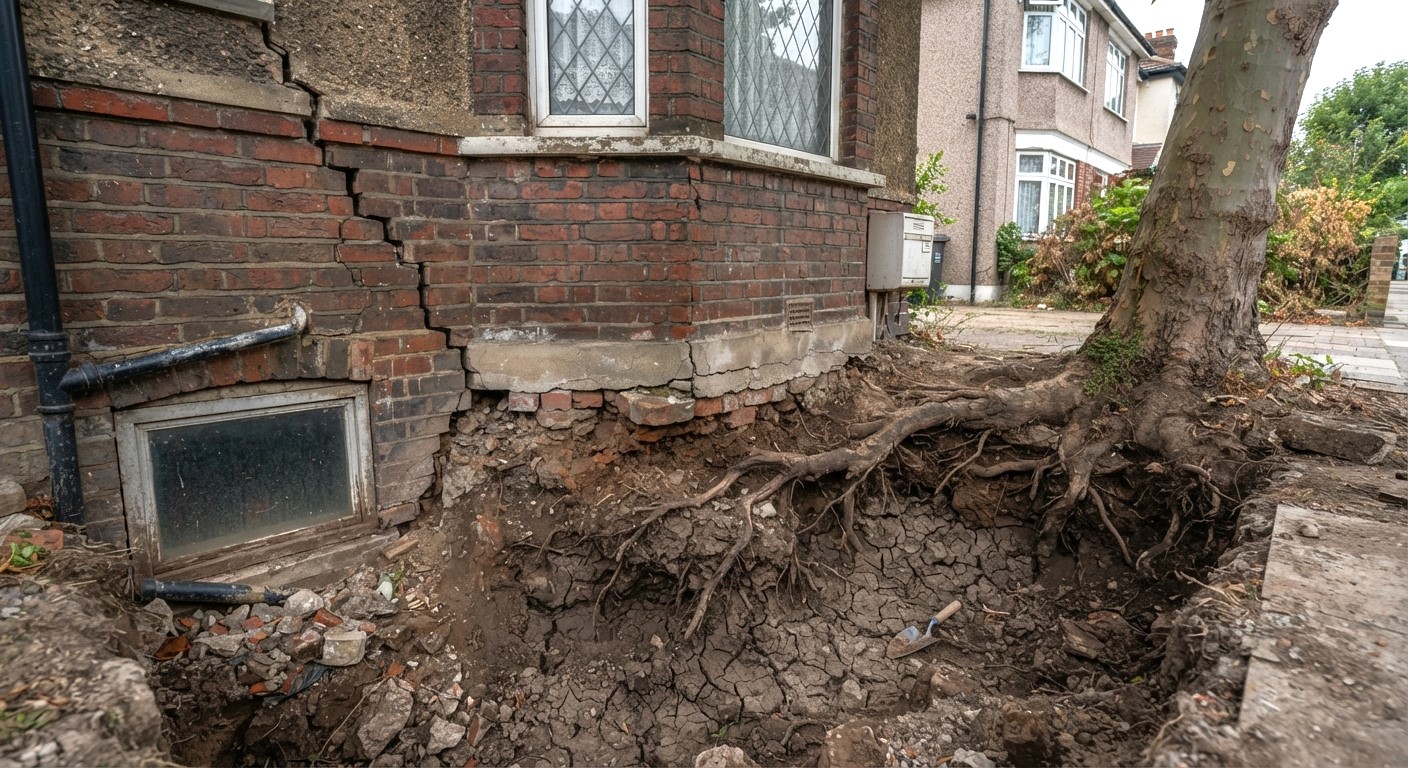
When a tree is growing in a water-sensitive, cohesive sub-soil, its roots act like giant underground straws. As the tree extracts groundwater, the volume of the sub-soil physically reduces. This localised drying out compounds the natural shrinkage caused by hot summer weather. When the soil shrinks, it pulls away from the underside of the building’s foundations, causing them to lose their bearing support and sag downwards. This mechanism is a classic form of tree root subsidence.
It is not just massive, towering trees that cause these issues. While oak, willow, sycamore, and cherry trees are well-known culprits, structural damage can also be triggered by smaller ornamental species. Even dense shrubs, large hedges, and climbers such as wisteria and rambler roses have been conclusively identified as the root causes of severe building movement.
The Opposite Danger: Ground Heave from Tree Removal
When property owners learn that a tree is damaging their home, their immediate instinct is often to chop the tree down. However, doing so without consulting a structural engineer or an arboriculturist can actually trigger an even worse structural failure known as ground heave.
- Buildings can be severely damaged when well-established trees are suddenly removed.
- When a mature tree is felled, it immediately stops extracting thousands of litres of water from the ground.
- Consequently, the desiccated clay sub-soil begins to slowly reabsorb moisture from rainfall, causing it to swell and expand back to its original volume.
- This swelling zone is concentrated directly around the decaying root system and can literally lift the surface of the ground—and the foundations resting upon it—by as much as 150mm.
- This process, known as ground heave, can take several years to fully complete, subjecting the building above to immense, prolonged upward pressures.
- Greenfield housing developments built on shrinkable sub-soils are particularly vulnerable to ground heave if the developers removed historical hedgerows or orchards shortly before laying the foundations.
The Domino Effect: Tree Roots, Clay, and Leaking Drains
The relationship between trees and clay soils is complicated further by the presence of underground drainage systems. Defective or leaking drains are a primary cause of subsidence in their own right, as escaping water can easily erode supporting soil beneath a foundation.
However, when trees are introduced to the equation, the risk multiplies.
- Tree roots are exceptionally aggressive in their search for moisture, especially during dry climatic conditions.
- It is incredibly common for the roots of willows and poplars to physically break into underground drain runs at weeping or defective mortar joints in order to access the water inside.
- As the roots exploit the leaking drain, their growth accelerates, leading to more extensive pipe blockages and larger fractures.
- The water leaking from the shattered drain then saturates the surrounding clay, creating highly localised pockets of soft, unstable soil that drastically reduce the bearing capacity of the foundations.
Vulnerable Structures: Why Extensions and Bay Windows Crack First
When investigating structural defects at Istidam Consulting, we often observe that subsidence does not affect a building uniformly. Instead, we frequently diagnose “differential settlement.” This occurs when separate parts of a building move at different rates or in completely opposite directions.
- Differential movement is extremely common in older domestic properties where light strip foundations were used to support single-storey porches, bay windows, garages, and conservatories.
- There is a dangerous, long-standing misconception in the building trade that lightweight structures do not require deep foundations.
- Because these smaller additions impose lower loads on the ground, their foundations were historically laid at very shallow depths.
- As a direct result, these shallow foundations are the first to be compromised by atmospheric drying, seasonal climatic changes, and the moisture-extracting influence of nearby tree roots.
The resulting structural damage is usually highly visible. The heavier main building remains stable, while the lightweight extension sinks into the shrinking clay. This differential movement typically causes a severe diagonal crack to open up at the junction between the two structures, often running down from the lower corner of a window or door frame.
The Evolution of Foundation Depths Near Trees
The widespread understanding of how shrinkable clays and trees interact is relatively modern. For much of the twentieth century, the building industry believed that digging a foundation to a depth of 750mm was perfectly sufficient to bypass the active zone of seasonal soil movement.
However, the catastrophic, nationwide subsidence events triggered by the severe UK droughts of 1975 and 1976 forced the industry to rethink its standards.
- Research stemming from these long, hot periods revealed that a depth of 750mm was woefully inadequate in highly shrinkable clays.
- Modern engineering guidelines now dictate that foundations in these soils must be formed at a minimum depth of 1200mm.
- If trees are present nearby, the foundations must be driven even deeper, or specially engineered piled foundations must be utilized, to bypass the tree’s root system entirely.
Spotting the Signs of Tree Root Subsidence: How to Read the Cracks
Not all cracks mean your home is sinking. Plaster often suffers from minor, hairline cracking due to harmless thermal expansion. However, foundation movement driven by clay shrinkage produces distinct visual signatures.
- Subsidence Cracks (Downward Movement): If a tree is actively drawing water and shrinking the clay beneath your home, the foundations will drop. The resulting cracks in the masonry will typically be diagonal, often ripping through mortar joints, and will generally be wider at the bottom than they are at the top.
- Heave Cracks (Upward Movement): If you have recently removed a large tree, the re-hydrating clay will push the foundations upward. This “hogging” effect creates cracks that are usually wider at the top and narrower at the bottom. You may also notice ground-floor window sills cracking and bowing upwards in the middle.
- Internal Signs of Subsidence: Beyond wall cracks, you may notice that ground-floor concrete slabs begin to slant out of level, paving slabs on your driveway crack, and internal doors or windows suddenly jam as their frames are pulled out of square.
The Istidam Consulting Approach: Expert Subsidence Investigation
Diagnosing whether a property is suffering from clay shrinkage, ground heave, or a completely unrelated issue (like a collapsed drain or a poorly constructed roof) requires the keen eye of a chartered structural engineer. Guesswork is not an option when the structural integrity of your home is at stake.
When Istidam Consulting is appointed to investigate severe building movement, we deploy a rigorous, multi-staged methodology:
- Comprehensive Desk Studies Before we even break ground, we conduct deep geotechnical research. We regularly access British Geological Survey (BGS) borehole logs to understand the subterranean strata beneath a client’s property. For example, by reviewing BGS logs, we can immediately identify if a property is sitting on highly shrinkable soil, which instantly elevates the risk profile if woody vegetation is present on the boundary.
- Trial Pits and Site Investigations A visual inspection above ground can only tell us so much. To definitively determine the nature and strength of the sub-soil, we must examine the foundations directly.
- This involves excavating trial pits—typically 1.20 metres square—adjacent to the affected walls to expose the footings.
- We assess the depth, width, and condition of the existing foundation concrete.
- Simultaneously, we may sink small boreholes or use hand augers to extract deep samples of the underlying clay.
- Laboratory Soil Testing The extracted clay samples are sent to a laboratory for sophisticated analysis.
- We subject the soil to Atterberg limit tests to determine its Plasticity Index (PI).
- By identifying the soil’s Liquid Limit and Plastic Limit, we can definitively classify whether the clay has a low, medium, or high shrinkage potential.
- If the tests reveal a high shrinkage potential (e.g., a PI above 40%), and the foundations are shallow, we have scientific proof that the soil is highly vulnerable to the moisture depletion caused by nearby root action.
- Crack Monitoring Programmes Current structural engineering practice actively avoids highly disruptive and expensive remedial works, such as underpinning, unless it is absolutely necessary. Historical data show that during severe droughts, clay will shrink drastically, but it often returns to a ‘safe’ or acceptable level of stability when normal weather patterns resume.
Therefore, unless the building is at immediate risk of collapse, we often implement long-term structural monitoring.
- We install crack monitoring tell-tales (transparent plastic plates with overlapping gridlines) across major cracks. These allow us to precisely measure both the amount and the direction of the movement over a period of 6 to 24 months.
- We may also utilise precise automatic levels and invar staff to conduct highly accurate plumb and level surveys of the property’s damp-proof course, tracking millimetre-scale shifts over time.
Formulating the Right Subsidence Repair Solution
Once we have gathered conclusive evidence, Istidam Consulting will design a targeted subsidence repair strategy. If the movement is confirmed to be historical and has ceased, we may simply recommend crack stitching to the masonry and repointing the brickwork with flexible lime-based mortar.
If the movement is active and driven by vegetation, we will collaborate with a qualified arboriculturist to determine the safest way to manage the trees—whether that involves aggressive pollarding, root barriers, or phased removal to prevent sudden ground heave.
In cases where the clay has been permanently compromised or the foundations are fundamentally inadequate, geotechnical engineers will design permanent structural solutions. This may involve extensive temporary shoring followed by targeted underpinning, taking the foundations down to a depth where the clay’s moisture content remains stable year-round.
Protect Your Property with Istidam Consulting
The interaction between heavy structures, shrinkable clay soils, and moisture-hungry trees is a complex feat of subterranean physics. Ignoring the early warning signs of subsidence or attempting amateur repairs can lead to catastrophic structural failure, rendering your property uninsurable and unsafe.
If your home is displaying signs of cracking, if your floors are sloping, or if you are concerned about large trees growing dangerously close to your boundary walls, you need professional guidance. Contact Istidam Consulting today. Our chartered structural engineers possess the expertise, equipment, and deep industry knowledge to advise you on stabilising your property and securing your peace of mind.
——— WHAT OUR CLIENTS SAY ———
Trusted By Clients Across The UK


 Trustindex verifies that the original source of the review is Google.
 Trustindex verifies that the original source of the review is Google.
 Trustindex verifies that the original source of the review is Google.
 Trustindex verifies that the original source of the review is Google.
 Trustindex verifies that the original source of the review is Google.
 Trustindex verifies that the original source of the review is Google.
 Trustindex verifies that the original source of the review is Google.
 Trustindex verifies that the original source of the review is Google.
 Trustindex verifies that the original source of the review is Google.
 Trustindex verifies that the original source of the review is Google.





Delivering Innovative, Safe and Sustainable Structural Solutions for Residential, Commercial and Industrial Projects
Useful Links
Solutions
Contact Info
Phone
+44 1392984211
+44 7514852513 (WhatsApp)
info@istidam.co.uk
Address
The Gallery, The Quay, Exeter, UK